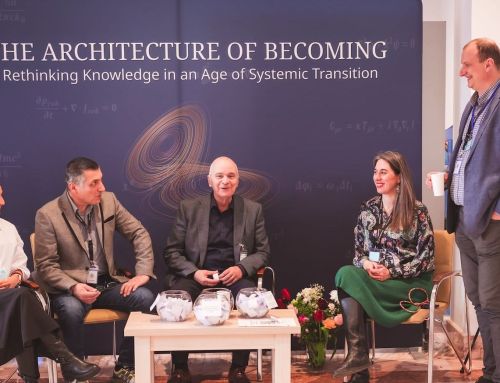
From Smart Technologies to the Semiotics of Life: A Collaborative Horizon in Forestry
Following the successful dialogues initiated at the 23rd International Conference on Smart Technologies & Education (STE 2026), a working meeting took place between the Laboratory of Forest Products (Faculty of Silviculture and Forest Engineering, Transilvania University of Brașov) and the team from the Centre for Complex Studies (CSC).
This inaugural meeting aimed at exploring the intersections of wood, trees, and forests through a multi-, inter-, and transdisciplinary lens. By shifting the focus from simple resource exploitation to the complexity of phenomena, the two teams are charting a course for a long-term collaborative calendar.

Mariana Domnica Stanciu – Laboratory of Forest Products, Faculty of Silviculture and Forest Engineering, UNITBV
Biosemiotics: A New Paradigm for Understanding Life
The core of the discussion revolved around Biosemiotics. As the participants noted:
“Biosemiotics is a new science of living, a new paradigm for biology—a theoretical framework that leads us to a deeper understanding of life itself.”
Moving beyond the material properties of wood, the dialogue touched upon the “language of nature,” where the forest is viewed as a complex communication system. This perspective aligns with the biosemiotic literature integrated into the proposed project, such as the works of Timo Maran, Felice Cimatti, and Stefano Mancuso, exploring the neuronal and semiotic aspects of plant life.

Florin Munteanu – Center for Complexity Studies and guests of the Laboratory of Forest Products, Faculty of Silviculture and Forest Engineering, UNITBV
Complexity: Seeking Meaning, Not Just Utility
The meeting emphasized a fundamental shift in scientific inquiry:
“Science begins where measurement is possible, but complexity begins when we seek meaning and an understanding of the world—not just its use.”
Drawing on the insights of Eve Mittleton-Kelly (London School of Economics), the teams discussed how complexity science is far from a management “fad” or a mere toolkit. Instead, it offers a transformative conceptual framework. As Mittleton-Kelly suggests, applying complexity to reality is not trivial; it requires a new state of mind, a fresh vocabulary, and a profound openness to fundamental change. It demands that we no longer hide from the individual responsibilities that arise from our actions within the ecosystem.
The Path Forward: An Open Project
The meeting concluded with a deep dive into the core concepts of complexity and the proposal of an Open Project, the CSC research signature. Designed as a dynamic and collaborative framework, an Open Project is intended to be a living engine for generating new insights, inviting researchers and students to contribute to a transdisciplinary study of the forest as a vital part of the Noosphere.
Key features of the Open Project research model include:
-
A Non-Linear Path: The “researcher’s path” often involves bifurcations, choices, and exploration of abandoned zones, reflecting the true nature of scientific inquiry.
-
Mentorship and Guidance: While participants provide the initiative, CSC specialists provide the foundational project structure and mentorship.
-
Methodological Support: Individuals benefit from rigorous scientific guidance and methodological support to help transform an initial idea into a formal research outcome.
-
Active Contribution: These projects offer direct opportunities for students and academics to contribute to fields seeking a deeper understanding of the world.

Emil Zaharia-Kezdi – Center for Complexity Studies
Planet Earth – A Living Planet
One such long-standing Open Project, discussed during this week’s meeting, focuses on Global Evaluation Techniques for Forest Health and derives from GAIA – the Living Planet – exploratory research program. The proposal seeks to integrate classical forestry with the Science of Complexity, utilizing tools such as fractal geometry, dissipative systems theory, and GAIA models to monitor and improve the quality of life within our forest ecosystems.
The Forest as an Ecosensor in the Study of Planetary Geostasy/Georesy Processes
An exploratory research program in Geonomy and original work initiated by Florin Munteanu.
This program represented a vanguard in Romanian research, proposing a fundamental paradigm shift in geosciences. It is based on the premise that Earth cannot be understood as an inert system, but as a Living Planet (GAIA), where geophysical processes are inextricably linked to the dynamics of the biosphere.
Core Pillars of the Project:
-
Non-linear Modeling of Geophysical Phenomena: Moving beyond classical models by using Complexity Science to understand Earth’s dynamics. A central focus is the multi-parametric monitoring of the Vrancea geodynamically active zone through state-of-the-art multi-dimensional systems.
-
The Biogeophysiology of Planet Earth: Conceptualizing the complex interaction between the Geosphere and the Biosphere. In this context, the forest ceases to be a mere resource and becomes a critical ecosensor—a neural system capable of reflecting the health and balance of the entire planet.
-
The Triad of Geostasy: Geosphere – Biosphere – Noosphere: The integration of the third layer, the Noosphere(the sphere of human knowledge), is essential. Studying the processes that ensure planetary geostasy (stability) and georesy (guided evolution) requires a transdisciplinary approach where human consciousness becomes an active factor in maintaining a living equilibrium.
Objective and Vision:
The “Planet Earth – A Living Planet” project aims to establish the theoretical foundation necessary for authentic sustainable development policies. Through this research, Complexity Science can provide the conceptual framework through which we can learn to “read” the messages of the forest ecosystem to ensure the future of human habitation on Earth.
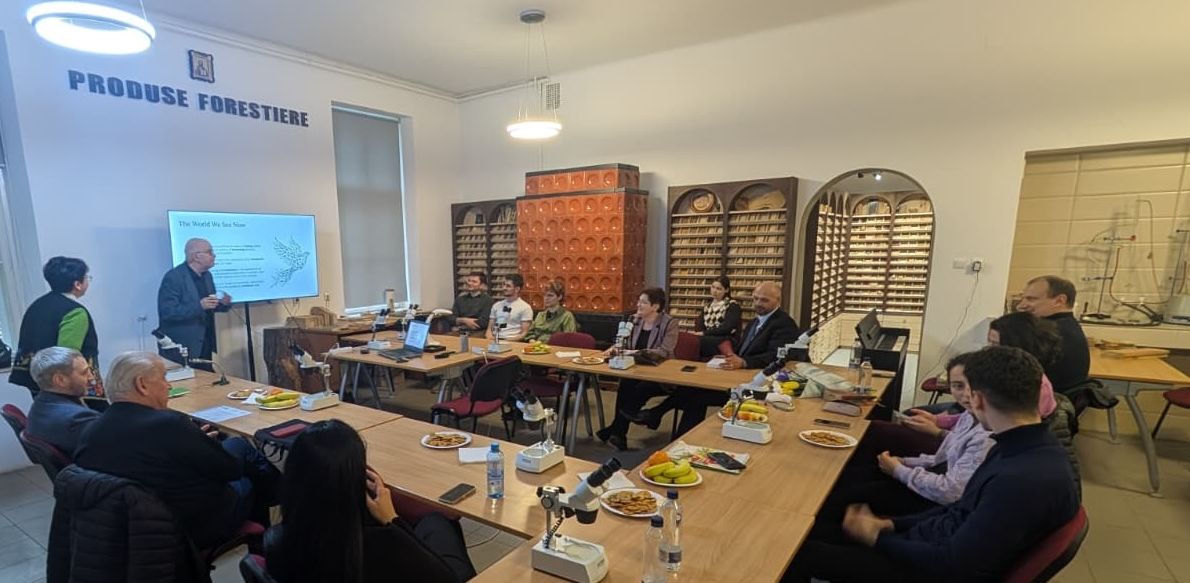
Florin Munteanu – Center for Complexity Studies and guests of the Laboratory of Forestry, Faculty of Silviculture and Forest Engineering, UNITBV
Bridging the Gap
By bridging the gap between pragmatic forestry and the profound interior experience of nature, the partnership between the Center for Complexity Studies and the Laboratory of Forest Products (Faculty of Silviculture and Forest Engineering, Transilvania University of Brașov) seeks to move from a “mechanics of systemic imbalance” toward a future of resonance and sustainability.
Further Suggested Reading :
-
Felice Cimatti – A Biosemiotic Ontology: The Philosophy of Giorgio Prodi, Springer.
-
Sungchul Ji – The Cell Language Theory: Connecting Mind and Matter, World Scientific.
-
F. Baluška, S. Mancuso, D. Volkmann (Eds.) – Communication in Plants: Neuronal Aspects of Plant Life, Springer.
-
Wendy Wheeler (Ed.) – Biosemiotics: Nature | Culture | Science | Semiotics.
-
Timo Maran – Mimicry and Meaning: Structure and Semiotics of Biological Mimicry, Springer.