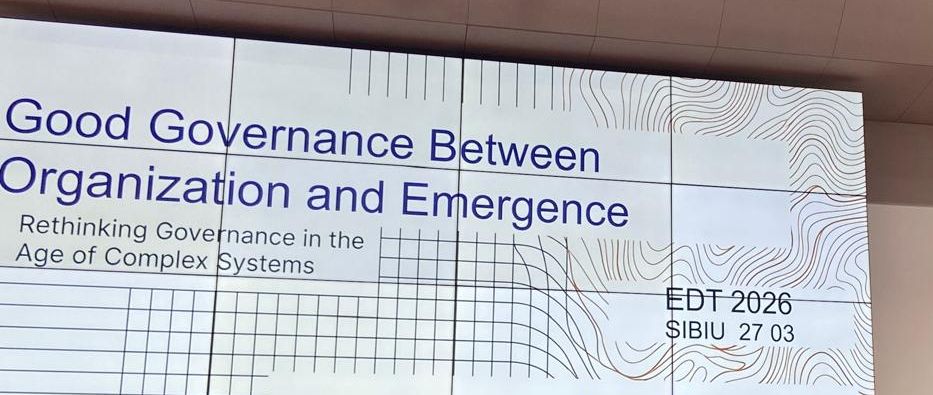
Good Governance Between Organization and Emergence. Rethinking Governance in the Age of Complexity
On March 27, 2026, the 5th Edition of the International Scientific Conference, “Emerging and Disruptive Technologies’ Impact on Global Security” (EDT 2026), convened in Sibiu. As a partner of the event, the Academy of Romanian Scientists (AOSR) highlighted the participation of distinguished experts addressing the complex security challenges of the modern era.
Among the invited speakers, Dr. Ing. Florin Munteanu—Founder of the Center for Complexity Studies and Full Member of the AOSR— presented in front of the plenary session the problem of “Good Governance Between Organization and Emergence: Rethinking Governance in the Age of Complexity”.
Governance as emergent function of the level of understanding
Dr. Munteanu’s presentation challenged traditional views of leadership, asserting that “Governance is not a property of position, but an emergent function of the level of understanding”. He argued that while roles like CEOs, governors, and educators remain essential, the conceptual framework defining them must evolve.
Historically, governance has been rooted in a “mechanistic paradigm” focused on prediction, planning, and direct intervention. However, in an age defined by interdependence and rapid technological disruption, Dr. Munteanu noted that leadership can no longer be reduced to the mere control of variables.
The current transition does not call these roles, nor the individuals who occupy them, into question. Rather, it reveals the limits of the conceptual framework within which these roles have been defined. In systems characterized by complexity, interdependence, and emergent dynamics, leadership can no longer be reduced to the control of variables. It requires the capacity to configure conditions, sustain coherence, and enable appropriate forms to arise.
Governance thus becomes more than an act of directing—it becomes an expression of how reality itself is understood: shifting from the mechanical organization of components to the cultivation of conditions in which order can emerge.
Governing for Emergence
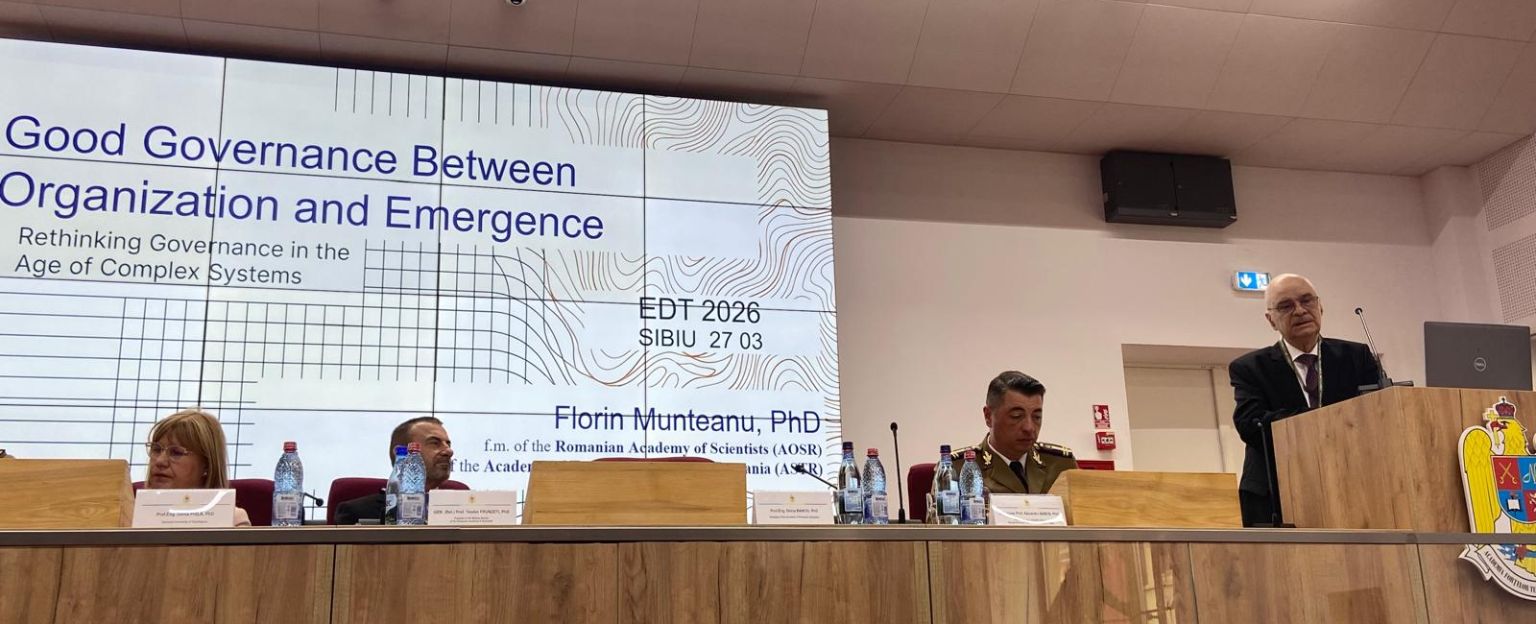
The paper emphasizes that effective governance in complex adaptive systems must operate in the delicate space between rigid organization and spontaneous emergence. Key highlights from the presentation included:
-
From Control to Cultivation: Governance is shifting from the mechanical organization of components to the “cultivation of conditions” where order and innovation can emerge naturally.
-
Four Axes of Change: The transition is visible across four dimensions: the Ontological shift (from continuous matter to informational structures), the Dynamic shift (from linear causality to nonlinear emergence), the Structural shift (from hierarchies to networks), and the Epistemic shift (from analytical modeling to simulation).
Strategic Coherence: In the context of global security, “Good Governance” involves maintaining strategic coherence while enabling decentralized initiative and adaptive decision-making.
The presentation concluded that the challenge of our time is not just developing advanced technologies, but developing the institutional and conceptual capacities to govern the complexity those technologies create. Dr. Munteanu’s vision calls for a “Good Governance” that provides stability without suppressing the adaptive capacities—such as distributed intelligence and local initiative—that allow systems to remain resilient in an uncertain world.
Read the paper in our Library.
For more information on the conference and its partners, visit the official AOSR website.