From Force to Coherence: AI-Assisted Detection of Relational Patterns
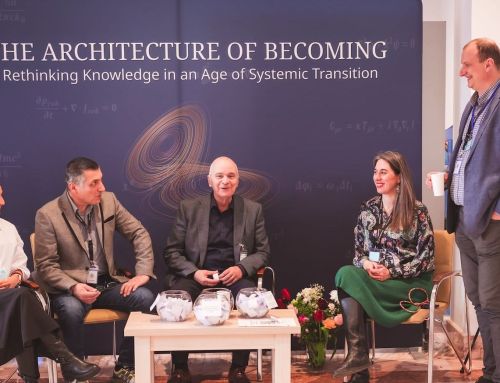
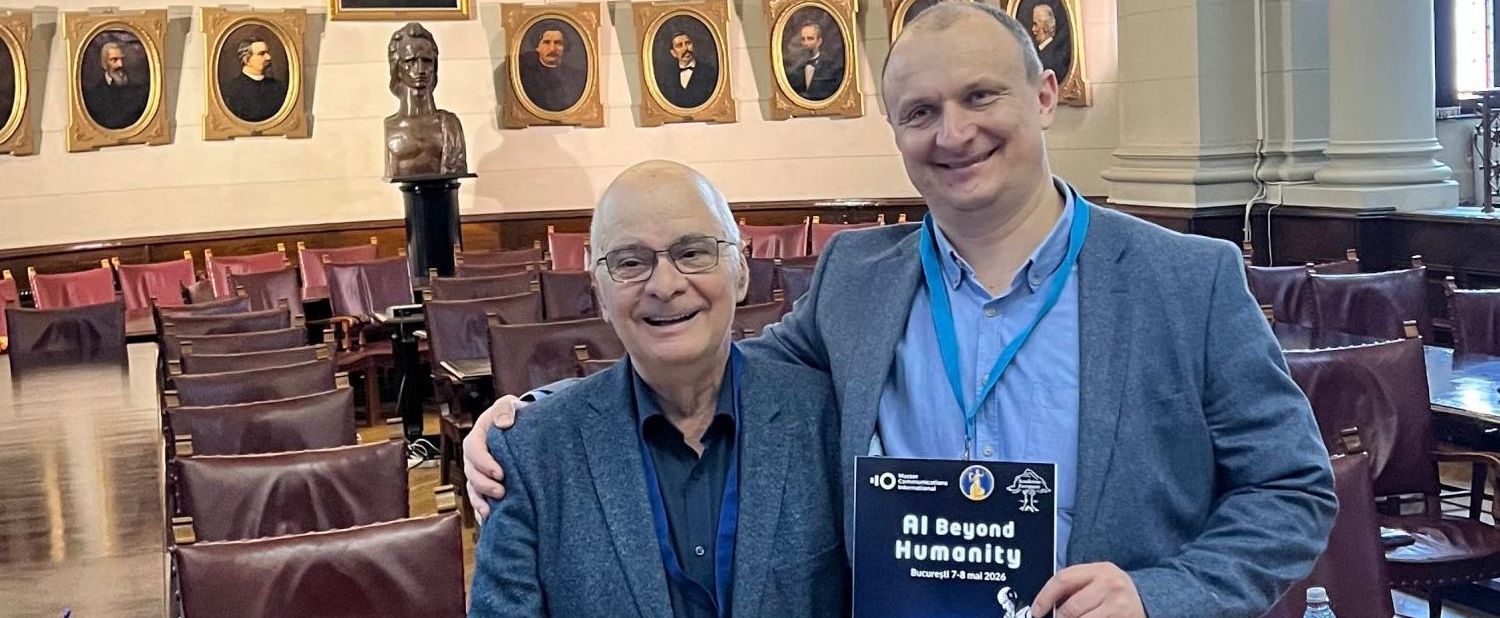
At the interdisciplinary conference “AI: Beyond Humanity,” held on 7-8 May 2026 at the Romanian Academy, a perspective for the future of science was presented by Dr. Florin Munteanu, PhD, Founder of the Center for Complexity Studies. His presentation marked a departure from traditional scientific inquiry, proposing an epistemic shift from a force-centered paradigm to a coherence-oriented perspective.
Toward an Epistemic Shift: Beyond the Force-Based Paradigm
For over a century, physics has excelled at quantifying the world through magnitude, direction, and energy exchange. However, as Dr. Munteanu explained, this classical framework encounters limits when faced with systems characterized by complexity and emergence. Influenced by developments in complexity science and quantum physics, this new perspective acknowledges that reality may not be fully describable as a collection of independent entities.
Instead, the focus is shifting toward phase, relational structure, and the role of the observer. In complex biological or environmental systems, the most critical phenomena are often weak, distributed, and context-dependent. Their signatures do not appear as strong causal chains but as subtle patterns of organization and synchronization. This led Dr. Munteanu to a central question: Can coherence itself be measured?
Read the paper and listen to the podcast summary on Academia.edu: Florin Munteanu
The m–v Framework: Redefining Matter and Interaction
To answer this, Dr. Munteanu introduced the m–v framework, a dual description of physical systems that aligns with the broader transformation in scientific thinking:
-
Mass (m) is reinterpreted as stabilized coherence—representing the persistence of a configuration over time, moving beyond simple inertia.
-
Vibrational Signature (v) represents the dynamic, phase-based unfolding of that configuration, capturing its internal rhythm and its capacity to resonate with other systems.
In this framework, interaction is driven not just by applied force, but by resonance and phase alignment, allowing systems to exhibit correlated behavior even with minimal energy exchange.
A Hierarchy of Sensing and the Rise of Ontosensors
The presentation outlined a hierarchy of sensing modalities designed to detect these relational structures:
-
Classical Sensors: Optimized for measuring isolated quantities like temperature or pressure.
-
Orthosensors: Systems sensitive to structural patterns and phase correlations.
-
Pseudo-Ontosensors: A hybrid architecture where Artificial Intelligence acts as an intermediate epistemic layer. By integrating physical sensors with AI-based interpretation, these systems can infer coherence structures that are invisible to classical analytical methods.
Methodological Probes: The Allais Effect
Dr. Munteanu applied this logic to the Allais effect—the anomalous pendulum behavior observed during solar eclipses. Rather than searching for a new force, he proposed using it as a methodological probe for differential measurement. By comparing a magnitude-sensitive gravimeter with a phase-sensitive pendulum, the systematic divergence between them—revealed through AI analysis—can serve as a signature of coherence-related perturbations.
A Transdisciplinary Celebration of Innovation
The presentation concluded by looking toward Future Extensions, including the study of Living Systems as coherence-sensitive components, viewing Ecosystems (GAIA) as distributed sensing networks, and exploring Informational Chemistry.
This vision was a highlight of the Hub Days, organized by the Academia Europaea Bucharest Hub in partnership with the “Mihai Drăgănescu” Artificial Intelligence Institute of the Romanian Academy. Beyond complexity science, the conference addressed AI’s impact on medicine, academic freedom, and dystopian risks.
Marking a new chapter for the Hub, the event also saw the announcement of two prestigious novelties: the creation of the Cantemir Medal and the Ioan Petru Culianu Prize, distinctions endorsed by the Board of the Academia Europaea to honor excellence in interdisciplinary research. These awards signify a commitment to the very kind of interdisciplinary excellence demonstrated by Dr. Munteanu’s quest to bridge the gap between raw data and meaningful coherence.
Read “From Force to Coherence: AI-Assisted Detection of Relational Patterns” and listen to the podcast summary on Academia.edu: Florin Munteanu