How Complexity Science is Redefining Forest Therapy and Human Health
The pristine, UNESCO-protected ancient beech forests of Strâmbu-Băiuț, Maramureș, recently served as the backdrop for a profound convergence of ecology, medicine, and advanced physics. On May 29–30, 2026, the second edition of the International Symposium on Forest Therapy (Simpozionul Internațional de Silvoterapie) brought together leading international researchers, foresters, and medical balneologists under the guiding motto: “Nature heals, and health begins in the forest.”
Organized by the Johannes Banfi Hunyades Multicultural Association from Baia Mare in partnership with WWF Romania and supported by Băiuț Town Hall, the symposium aimed to ground the empirical, ancient practices of “forest bathing” (Shinrin-yoku) into concrete scientific frameworks. Central to this mission were the back-to-back presentations delivered by the delegation from the Center for Complexity Studies (CSC), which introduced an entirely new, non-linear paradigm for understanding human healing and planetary ecology.
Part 1: Decodifying the Architecture of Resonance
Drd. Emil Canciu on the Objective Fingerprints of Therapeutic Sound
Opening the CSC session, researcher Drd. Eng. Emil Canciu delivered a presentation co-authored with Prof. Dr. Florin Munteanu, entitled “Decodifying the Architecture of Resonance: The Discriminating Music Sequences (DiMuSe) methodology for identifying the objective fingerprints of therapeutic sound.” Read and download the work from our Library.
                     [ AUDIO INPUT: Raw Sound Wave ]
                                    │
                                    ▼
                  [ DiMuSe Vectorization (4 Pillars) ]
      ┌───────────────────┬───────────────────┬───────────────────┐
      ▼                   ▼                   ▼                   ▼
[ STATISTICS ]   [ FRACTAL GEOMETRY ] [ NONLINEAR PHYSICS ] [ COMPLEX SYSTEMS ]
(Std Deviation) (Smoothness/Raw Shape) (Spectral Entropy)  (Hurst Exponent)
      │                   │                   │                   │
      └───────────────────┴───────────────────┴───────────────────┘
                                    │
                                    ▼
                     [ Principal Component Analysis ]
                       (71.52% Variance Extraction)
                                    │
                                    ▼
               [ RELAXATION CLUSTER: Pink Noise, Ocean, Track ]
The Ontological Shift: Music as Information
Drd. Canciu began by highlighting a long-standing analytical gap in music therapy: traditional evaluations rely almost exclusively on subjective descriptors, individual aesthetic tastes, and cultural conditioning. Because of this, the precise structural mechanisms driving therapeutic efficacy have historically remained hidden.
To bypass these subjective filters, the CSC team proposed a radical ontological shift: treating therapeutic sound not as an art form, but as a structured informational process. Instead of analyzing melody, harmony, or lyrical meaning, their methodology evaluates raw signal shape, temporal processing, fractal geometry, and structural persistence.
The DiMuSe Methodology: From Geophysics to Acoustics
The engine behind this research is the DiMuSe (Discriminating Music Sequences) framework. This methodology was adapted from non-linear signal processing techniques originally engineered in geophysics to detect subtle, hidden precursors to earthquakes. Applied to acoustics, it operates under the premise that therapeutic outcomes are driven by underlying structural regularities that can be mathematically mapped and anticipated.
The core computational tool, DiMuSeVectorise, translates raw, uncompressed audio files into an informational signature represented by a 24-dimensional mathematical vector. This vector completely discards traditional musical notation, evaluating the acoustic signal across four main complex systems pillars:
-
Statistics: Mapping basic physical parameters such as the standard deviation of the wave.
-
Fractal Geometry: Measuring metrics like the smoothness dimension of the sound shape.
-
Nonlinear Physics: Calculating power spectrum entropy.
-
Complex Systems: Evaluating the Hurst exponent, which tracks long-term memory and structural persistence within time-series data.
Because interpreting a 24-dimensional vector is highly complex, the methodology applies Principal Component Analysis (PCA). PCA compresses this multi-dimensional data space into a simplified visual layout while successfully retaining 71.52% of the fundamental structural variance, forcing hidden organizational patterns to emerge as distinct, visible data clusters.
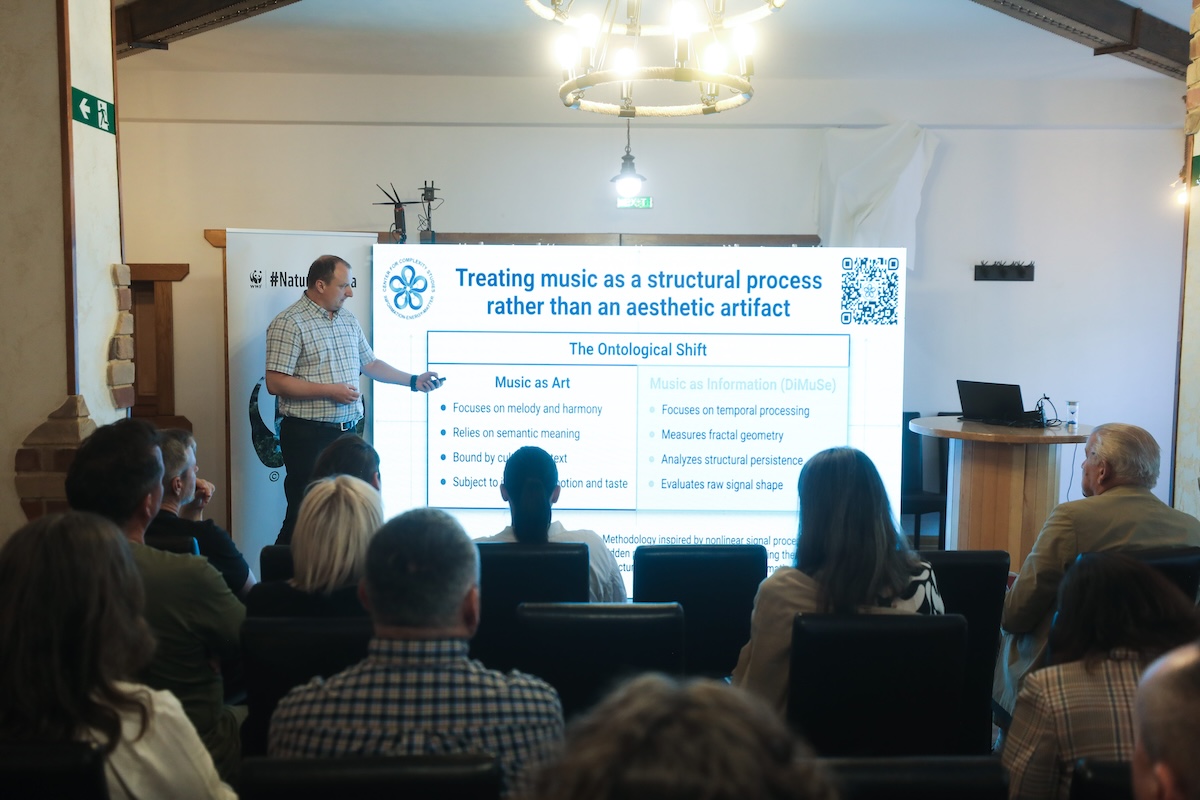
Emil Canciu – Center for Complexity Studies presenting DiMuSe (Discriminating Music Sequences) framework
Key Findings and Blind Cross-Validation
When DiMuSe blindly mapped a diverse array of audio files, the results were startling:
-
The Relaxation Cluster: Human-engineered therapeutic tracks, pink noise, and organic natural sounds (such as ocean waves) automatically gravitated toward the exact same isolated mathematical cluster. This objectively proved that effective healing music shares an inherent mathematical architecture with the ambient acoustic dynamics of the natural world.
-
Replicating Clinical Data: The algorithm was tested blindly on a dataset from an independent clinical trial in South Korea. Without prior access to the medical outcomes, DiMuSe isolated the track “Cozy Arirang” as having the highest structural therapeutic vector, perfectly matching the physical relaxation responses recorded in the human patients.
-
The Mindlab Breakthrough: Similarly, when analyzing a widespread audio dataset, DiMuSe independently singled out the track “Weightless”—a piece famously custom-engineered by neuroscientists to lower heart rates—as possessing the highest therapeutic structural signature in the set.
-
Real-Time Dynamic Tracking: DiMuSe proved capable of tracking how therapeutic efficacy fluctuates minute-by-minute within a single track. In “Weightless”, it mapped a clear two-phase architecture: a Phase 1 gradual structural escalation designed to systematically build and induce the physiological relaxation state, followed by a Phase 2 intentional structural diminution to safely stabilize the listener’s physiology at the track’s conclusion.
Part 2: Scaling Up to Planetary Coherence
Dr. Florin Munteanu on the Gaia Perspective and Forests as Orthosensors
Right after Emil Canciu concluded his presentation, showcasing how localized sound waves can anchor human physiological states, Prof. Dr. Florin Munteanu (Founder President of the CSC) took the stage. Dr. Munteanu’s presentation seamlessly expanded these concepts from the scale of human biology to the scale of the entire biosphere, introducing a profound paradigm shift toward the Gaia Perspective.
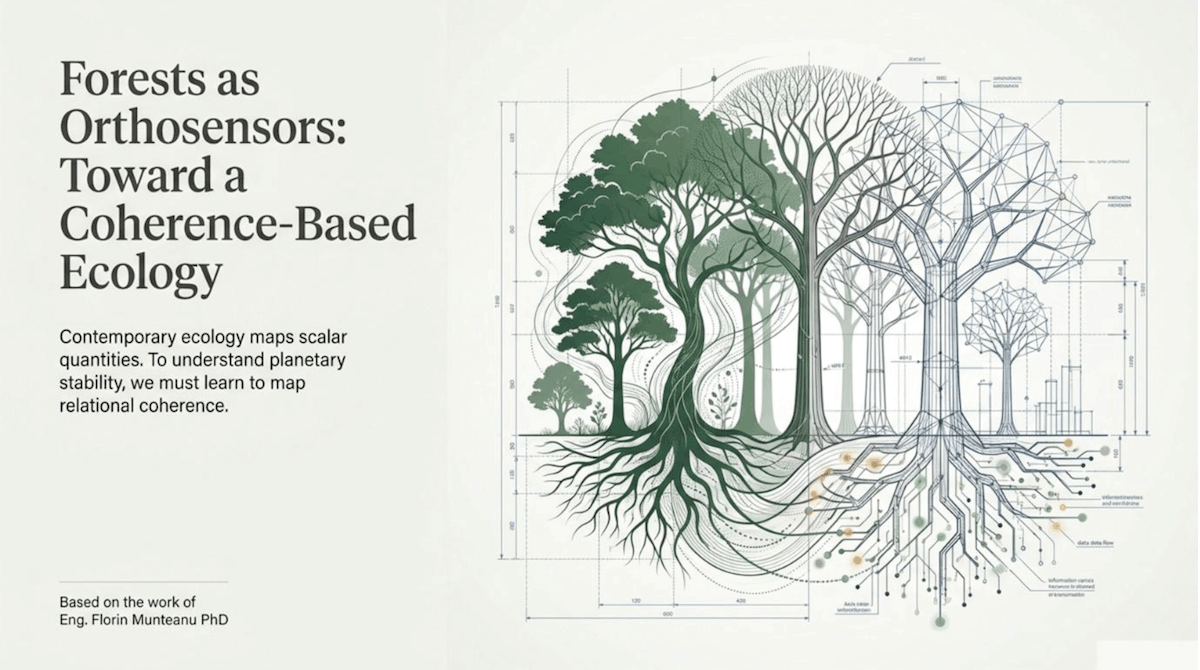
The Forest as an Orthosensor
In his lecture, titled “The Forest as a Living Sensor: Toward a Coherence-Based Ecology,” Dr. Munteanu challenged the foundational architecture of modern environmental monitoring. While contemporary ecology relies on ultra-precise measurements of scalar quantities—such as localized temperature, humidity, CO₂ levels, and biomass—these numbers fail to capture the deep, relational organization that allows ecosystems to actively preserve regional and global stability.
To bridge this gap, Dr. Munteanu introduced the concept of the Orthosensor. Unlike a standard linear sensor that reacts merely to changes in magnitude (amplitude), an orthosensor is an adaptive complex system sensitive to relational organization, phase compatibility, delayed structural coupling, and long-range coherence dynamics.
Under this framework, a forest—such as the 598-hectare secular beech canopy of Strâmbu-Băiuț—is reinterpreted as par of a massive, distributed planetary orthosensor network. It does not passively absorb environmental fluctuations; it actively senses, integrates, and redistributes relational tensions across scales.
Read and download the work – The Forest as Orthosensor – on Academia.edu
The Conservation of Coherence and Geostasis
This perspective offers a major upgrade to James Lovelock’s classical Gaia hypothesis. Rather than treating planetary self-regulation as a mechanical search for a static equilibrium, the CSC model posits that Gaia operates under a fundamental principle of the conservation of coherence.
When environmental disruptions occur, the biosphere maintains integrity through continuous, adaptive structural transformations—a state Dr. Munteanu terms planetary geostasis. Within this grand system, forests act as the primary operational interfaces and planetary actuators, translating atmospheric, hydrological, and energetic variations into a unified, coherent relationship that keeps the biosphere habitable.
Part 3: Synchronization—The Future of Health and Ecology
Identifying the Limits of the Study
As with any pioneering scientific framework, the CSC delegation explicitly outlined the current limitations of their models to chart a path for rigorous future validation:
-
Unaccounted Variance: While the DiMuSe algorithm successfully reduces multi-dimensional complexity through PCA, the current model leaves 28.48% of the total structural variance unaccounted for. Refining the mathematical parameters to capture this missing data is a primary focus of ongoing work.
-
The Subjective Interface: Although DiMuSe isolates the intrinsic informational constraints of a sound wave that act as a baseline for biological stability, it does not completely eliminate individual psychological filters, personal emotional history, or specific cultural conditioning.
-
The Need for Biometric Integration: To mature into a standardized medical tool, these mathematical audio vectors must be directly cross-validated in real-time against human biometric feedback, including Heart Rate Variability (HRV) and EEG phase-locking data.
Redefining Health Through Phase Synchronization
Despite these limitations, the back-to-back presentations by Drd. Canciu and Dr. Munteanu established a scale-transcending definition of health rooted in the advanced M4–Poiesis epistemological model.
Moving away from the Western biomedical view of health as the mere “absence of disease” or optimal localized mechanical performance, the CSC research team defines health as:
The dynamic capacity of a living system to conserve and reorganize relational coherence across all its levels of manifestation—molecular, cellular, cognitive, emotional, social, and ecological—maintaining dynamic compatibility between structure, function, environment, and experience amidst continuous transformation.
Within this non-linear paradigm, chronic illness and pathological states are redefined as a progressive decoupling of phase and structural fragmentation between biological subsystems.
   [ PLANETARY SCALE ]      Planetary Geostasis & Gaia Coherence
                                      ▲
                                      │  (Scale Continuity)
                                      ▼
   [ ECOSYSTEM SCALE ]      Forests as Distributed Orthosensors
                                      ▲
                                      │  (Acoustic/Resonant Anchors)
                                      ▼
   [ HUMAN BIOLOGY ]        Health as Multi-Level Phase Synchronization
This completely transforms the future of musicology, bio-acoustics, and medicine. Environmental acoustics and therapeutic sounds are no longer viewed as subjective, aesthetic tools to change a patient’s “mood.” Instead, they are recognized as external coherence anchors. The fractal, persistent, and highly structured mathematical signatures found in both human-engineered healing tracks and intact natural environments possess the objective power to entrain, couple, and resynchronize broken human biological rhythms, pulling them back into alignment with the stabilizing baselines of the ecosystem.
The Next Steps for Strâmbu-Băiuț
The symposium concluded with an ambitious roadmap for the Center for Complexity Studies to continue existing collaboarations and start new ones. For example, by pivoting the DiMuSe methodology from acoustics directly to forest ecology, the CSC could map and decode the baseline informational and bio-acoustic architecture of the pristine, UNESCO-protected ancient forests of Strâmbu-Băiuț.

The site „Codrii Seculari de la Strâmbu-Băiuț” has been part of the UNESCO patrimony since 2017
By extracting such objective, regional “vibrational fingerprints,” science could be able to mathematically anticipate, design, and prescribe specific forest environments custom-tailored to restore phase synchronization and heal precise chronic pathologies in human patients. By bridging the gap between local biological homeostasis and planetary geostasis, science can prove that nature does not just heal metaphorically—it synchronizes us back to life.